Chapman-Mitchell relay catch turns NZ vs UAE T20 World Cup 2026 clash
T20 World Cup 2026: Relay Catch by Chapman & Mitchell Turns Tide in NZ vs UAE Clash
The 11th encounter of the ICC Men’s T20 World Cup 2026 turned into a textbook example of how a single fielding moment can swing a tight chase. In Chennai’s humid night, a relay catch by Mark Chapman and Daryl Mitchell erased a rising threat from Alishan Sharafu, reshaping the narrative of the New Zealand vs United Arab Emirates clash.
Match Context and Momentum Shifts
Group D’s opening act saw the UAE elect to bat, a decision that paid off with a healthy 173/6 on a surface that was slowly gaining bite under the lights. Muhammad Waseem anchored the innings with a quick‑fire 66*, while Sharafu, fresh on a 55‑off‑47‑ball cameo, was steering the side toward a commanding total. New Zealand, fresh from a win against Scotland, entered the field with their own batting depth in question, making the early breakthroughs essential.
Tactical Choices and Bowling Plans
New Zealand’s captain, Mitchell Santner, set a clear plan: attack the top order and force the UAE into a defensive stance. Santner opened the spell with a wide‑outside‑off delivery, hoping to catch Sharafu off‑balance. The gamble worked, but Sharafu answered with a powerful sweep aimed at deep mid‑wicket—a shot that seemed destined for the boundary rope.
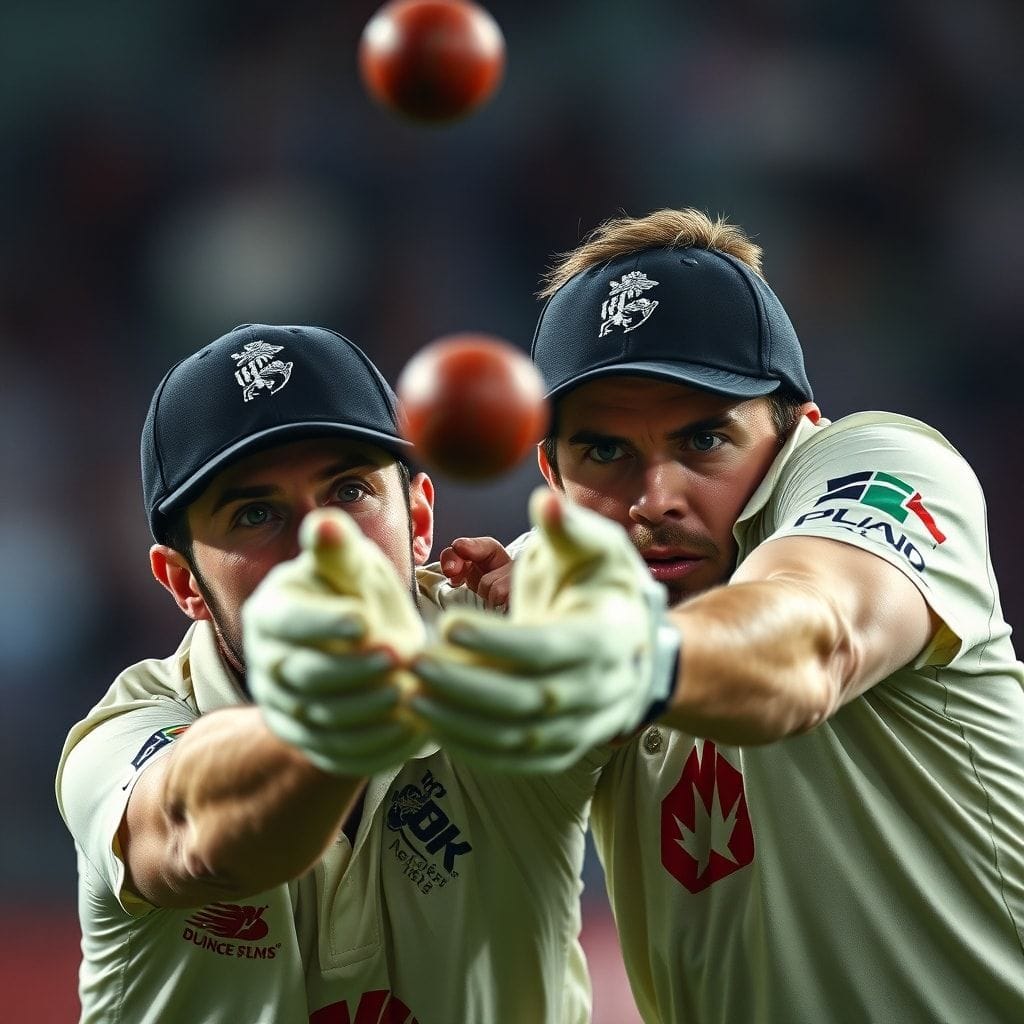
Chapman, stationed at the mid‑wicket fence, sprinted full‑tilt, timing his run perfectly to meet the ball inches from the rope. Realising his momentum would carry him over the boundary, he launched an instinctive aerial toss back into the field just as his foot touched the grass beyond. Mitchell, reading the lob from the square leg region, collected it cleanly, sending Sharafu’s innings crashing back to the pavilion. The relay catch not only broke a 107‑run partnership but also injected a burst of confidence into the Black Caps’ fielding unit.
Player Mindset and Role Adaptation
For Chapman, the catch was a showcase of his evolution from a batting‑centric role to a full‑time all‑rounder who values fielding as an equal weapon. His decision to sprint deep, rather than hold his ground, reflected a mindset that every ball is an opportunity. Mitchell’s composure under the high‑pressure lob displayed his veteran instincts; having played countless tight chases, he knows when to stay calm and let the ball come to him.
Sharafu, on the other hand, embodied the associate’s hunger to upset a tier‑one side. His aggressive sweep demonstrated a willingness to take risks, but the cost was a wicket that could have easily turned into a six. The lesson for emerging associate batsmen is the balance between intent and execution, especially on foreign pitches.
The Stats Behind the Strategy
| Player | Runs (NZ) – Balls | Runs (UAE) – Balls | Bowling Econ (4 overs) | Key Fielding Moment |
|---|---|---|---|---|
| Mark Chapman | 22 – 18 | — | — | Relay catch with Mitchell |
| Daryl Mitchell | 45 – 31 | — | — | Collected Chapman’s toss |
| Mitchell Santner | — | — | 5.75 | Opening wicket of Sharafu |
| Alishan Sharafu | — | 55 – 47 | — | Dismissed via relay |
| Muhammad Waseem | — | 66* – 45 | — | Anchor innings |
From a statistical lens, the catch contributed directly to a 21‑run swing – Sharafu was on 55 with the run‑rate accelerating, while New Zealand’s required run‑rate after the wicket rose sharply. Santner’s economy of 5.75 in the middle overs underscored New Zealand’s discipline, but it was the fielding effort that prevented the UAE from posting a daunting 190‑plus total.
Venue‑Specific Insights
Chennai’s M.A. Chidambaram Stadium is notorious for its low‑bounce, slow‑turning tracks. Historically, Sri Lankan and Indian batters thrive, while seamers often need to exploit the inherent reverse swing in the night air. Chapman’s agility on the hard, slightly gritty outfield made his boundary‑line sprint feasible, and Mitchell’s soft‑hands finish benefited from the relatively dry pitch that produced predictable bounce.
Tournament Impact and What Lies Ahead
With the win, New Zealand keeps alive their hopes of topping Group D, while the UAE’s spirited performance cements them as a dark horse capable of challenging any full‑member nation. The Black Caps now need to chase 174 in the final ten overs, a scenario that tests depth and composure. A success would boost morale ahead of their next fixture against the West Indies, a match where their middle order will face a potent West Indian spin attack.
The UAE, despite the loss, will enter the final group game with confidence. Their ability to post 173 on a traditionally low‑scoring surface suggests that their batting line‑up can adapt to varying conditions, a trait that could be decisive in the Super 12 stage.
Fan Perspective and Grounded Opinions
Local fans in Chennai were treated to a reminder that T20 cricket is as much about fielding as it is about power‑hitting. Social media buzz highlighted Chapman’s airborne toss as “the catch of the tournament,” while many pointed out that such moments often swing the momentum in what otherwise feels like a batting‑dominated format.
From a broader viewpoint, the game reinforced the growing parity between associate and full‑member nations. The UAE’s aggressive approach, especially Waseem’s six‑hitting streak, gave fans a reason to believe that the associate tag is becoming a relic. New Zealand’s reliance on fielding brilliance rather than sheer firepower sparked debate about whether their batting depth still needs reinforcement.
In the end, the relay catch will be remembered not just as a spectacular athletic display but as a tactical pivot that reminded players and supporters alike that every run saved is as valuable as a run scored. As the tournament progresses, the lesson is clear: fielding excellence can be the differentiator in the tightly contested chase for the T20 World Cup trophy.
Cricket Desk: Want more on Associate cricket strategy? Check out our Associate cricket strategy Latest News & Stats.